From Chaos to Resilience
A practical journey on incidents, reliability, communication and decision-making in critical environments. Learn to turn crises into growth opportunities.
What are you gonna do? learn
A complete experience that connects theory and operational practice. From managing critical incidents to building resilient systems, through effective communication and decision-making under pressure.
Incident Management
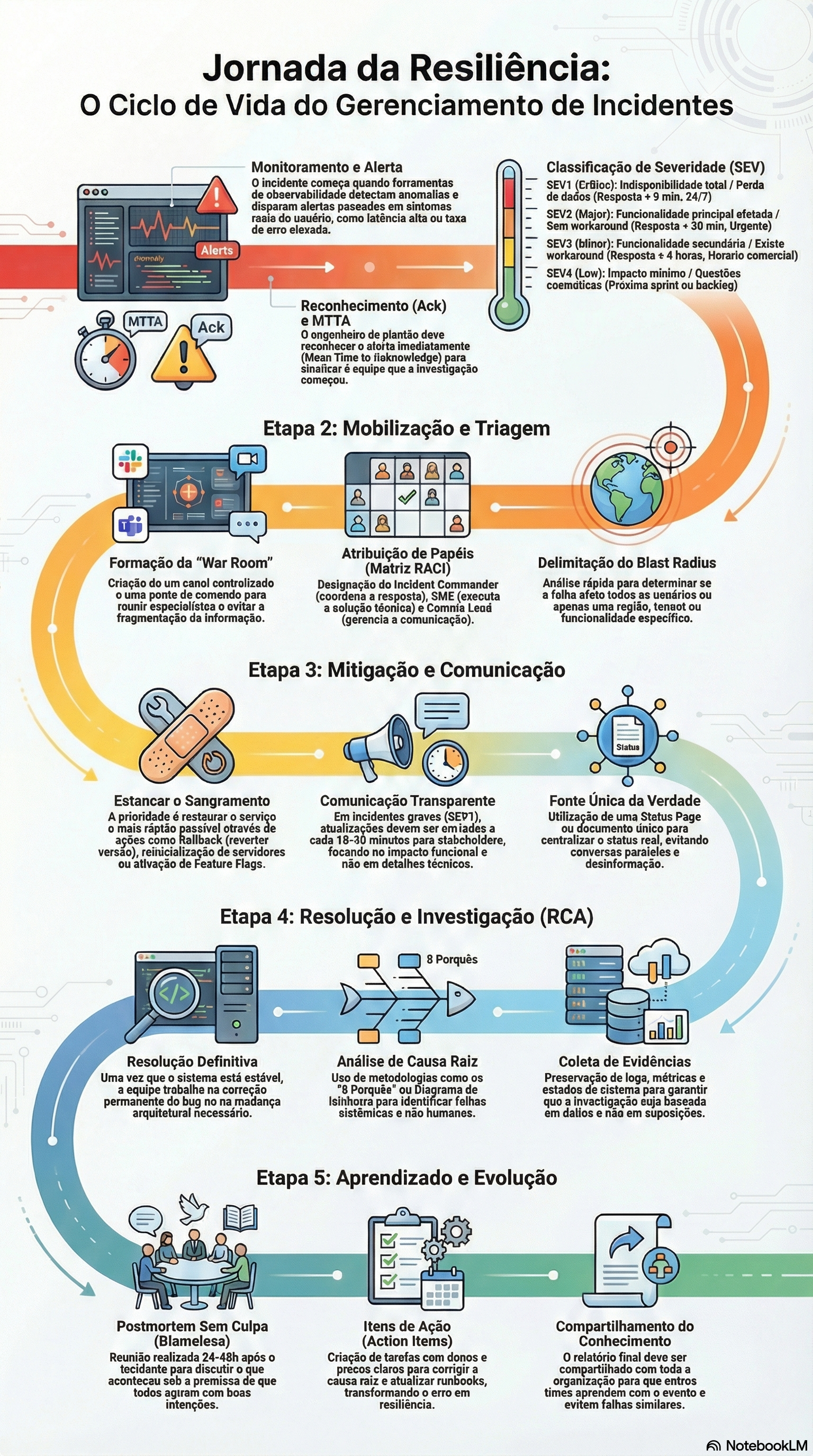
Processes, roles and tools for effective response to critical incidents.
Crisis Communication
How to keep stakeholders informed and manage expectations under pressure.
Agile Diagnosis
Techniques to identify root causes and prioritize high impact corrective actions.
Pressure Decision
Critical trade-offs between fixing the system and managing the business crisis.
Organizational Resilience
Building blameless culture and implementing continuous learning processes.
SRE in Practice
SLOs, error budgets, postmortem elaboration and real reliability engineering.
Reasons Support
A complete guide for developers and engineers working with production systems.
It runs from key concepts to advanced reliability engineering strategies.
Target Audience
Discussions Deep
Detailed analyses of real dilemmas faced by support teams. Listen wherever and whenever you want.
From Chaos to Resilience in Critical Incidents
Discussion on how teams evolve from reactive response to proactive incident management. Approach culture, processes and tools.
Fix the System or Manage the Crisis?
Deep analysis of the central dilemma of incidents: when to prioritize technical correction versus business impact management. Trade-offs and tough decisions.
Production Reliability Engineering
Full presentation covering SRE, ITIL, Incident Management, playbooks, postmortems and blameless culture. Reference material for practical implementation.
In short
From chaos to resilience in production
Supporting critical systems is more than putting out fires: it is a discipline of reliability, communication and decision under pressure. The journey goes from reactive chaos to resilience, where incidents have become learning and the system becomes stronger with each failure.
- Incidents as a sign — each failure reveals a weakness to be corrected at the root.
- Measurable reliability — SLIs/SLOs instead of " appears stable".
- Crisis communication — clarity and cadence reduce collateral damage.
- Decision under pressure — previously defined criteria avoid panic in the incident.
Frequently Asked Questions
Frequently Asked Questions
What is support of production systems?
It is the discipline to keep critical systems reliable in operation: prevent, detect and respond to incidents, measure reliability (SLIs/SLOs) and learn from each failure to strengthen the system. It goes beyond reactive support — it is reliability engineering.
How to get out of reactive chaos?
Changing individual heroism by method: instrument reliability with metrics, define decision criteria before the incident, standardize crisis communication and treat each incident as a learning that corrects the root cause.
Why does communication matter so much in an incident?
Because much of the damage to an incident is collateral — customers, teams, and leadership in the dark. Clear communication with defined cadence contains anxiety, aligns the answer and preserves confidence while the problem is solved.